Why this new GPU route deserves a closer look
Renting a GPU often means choosing hardware, configuring an image, moving files, installing tools and keeping track of storage before useful work begins. Higgsfield is approaching that problem from the other direction. Higgsfield presents the rental as a cloud computer with suitable applications and AI controls already around it.
That makes it relevant to creators, solo developers and small teams who care about time to first useful result as much as the raw GPU rate. It also creates a new comparison problem: Higgsfield charges GPU time in credits, while services such as Runpod and Vast.ai commonly expose a dollar-denominated compute rate. This first look translates those credits, identifies what the public pages establish and records what still needs a hands-on test.
Why Higgsfield's move into GPU rental makes sense
Higgsfield already turns image and video requests into GPU-backed creative work. GPU rental extends that relationship from buying a managed output to controlling the workspace that produces it. The same users who generate, fine-tune or render through Higgsfield may also want direct access to models, tools, files and GPU memory while keeping a guided experience around the infrastructure.
From using Higgsfield's creative tools and from benchmarking rented GPU inference, I recognise the position. These services sell a faster route from an idea to a completed result. The useful cost comparison is therefore broader than the GPU-hour. It includes active credits, setup time, file transfer, workspace persistence, reruns and the engineering time saved by the prepared environment.
What is Higgsfield GPU rental?
Higgsfield describes its GPU product as a way to rent a cloud computer for model inference, rendering and creative applications. A user can choose a GPU, select a template or custom setup, review the price and launch a workspace. The product material shows use cases including Blender, ArtCraft, LoRAs, image generation, video work and language models.
This is broader than a model API and more guided than renting a plain virtual machine. The practical value depends on how well the included workspace reduces setup, file movement and recovery work for the job at hand.
Higgsfield also says the GPU route is available inside Supercomputer with the /gpu command. Its product page presents the workspace as interactive from Claude, ChatGPT and Supercomputer. That chat entry point changes how a user starts a machine. A complete evaluation still covers the hardware, data path and running cost.
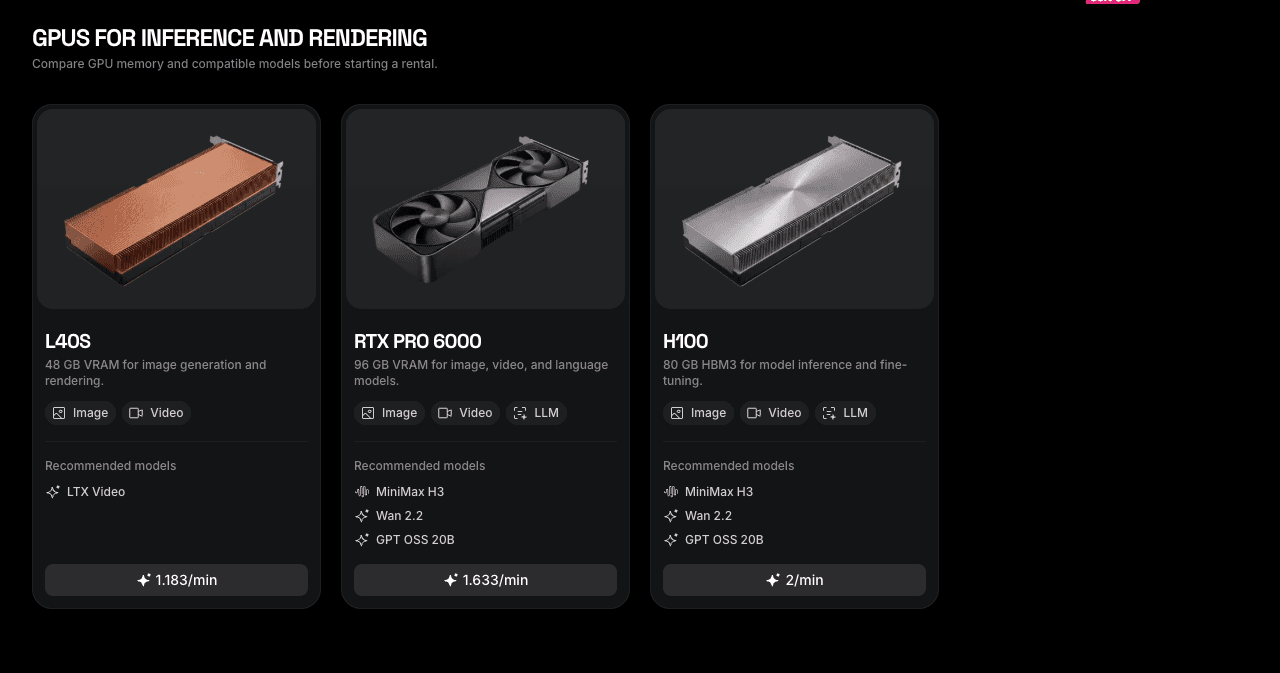
Higgsfield GPU prices in credits
The public catalogue gives a credit-per-minute figure for each available GPU. Multiplying that figure by 60 produces the credit cost for one uninterrupted hour. Rubin is also shown in the catalogue, with access handled through sales rather than a public rate.
| GPU | Memory | Published credits/min | Derived credits/hour |
|---|---|---|---|
| L40S | 48 GB | 1.183 | 71 |
| RTX PRO 6000 | 96 GB | 1.633 | 98 |
| H100 | 80 GB HBM3 | 2.000 | 120 |
| H200 | 141 GB HBM3e | 2.233 | 134 |
| B200 | 180 GB HBM3e | 2.933 | 176 |
| B300 | 288 GB HBM3e | 3.283 | 197 |
The credit rate is a consumption unit rather than a full infrastructure price breakdown. The public pages present GPU compute, CPU, system memory, storage, transfer, workspace features and platform margin as an unitemised credit rate. This makes the derived hourly figures useful for orientation, while the cost and value of a completed workload remain the stronger comparison.
How credits become an effective GPU price
The dollar value of a credit varies across the current plans. On the checking date, Higgsfield displayed Starter at $19 a month billed yearly with 270 monthly credits, Plus at a promotional $30 a month billed yearly with 1,200 credits, and Ultra at a promotional $45 a month billed yearly with 3,000 credits. The page also displayed higher crossed reference prices for Plus and Ultra. The calculation uses the active billed-yearly amounts only. These prices were displayed in a UK browsing session before checkout tax. Higgsfield states that plans, prices and credit amounts can vary by country.
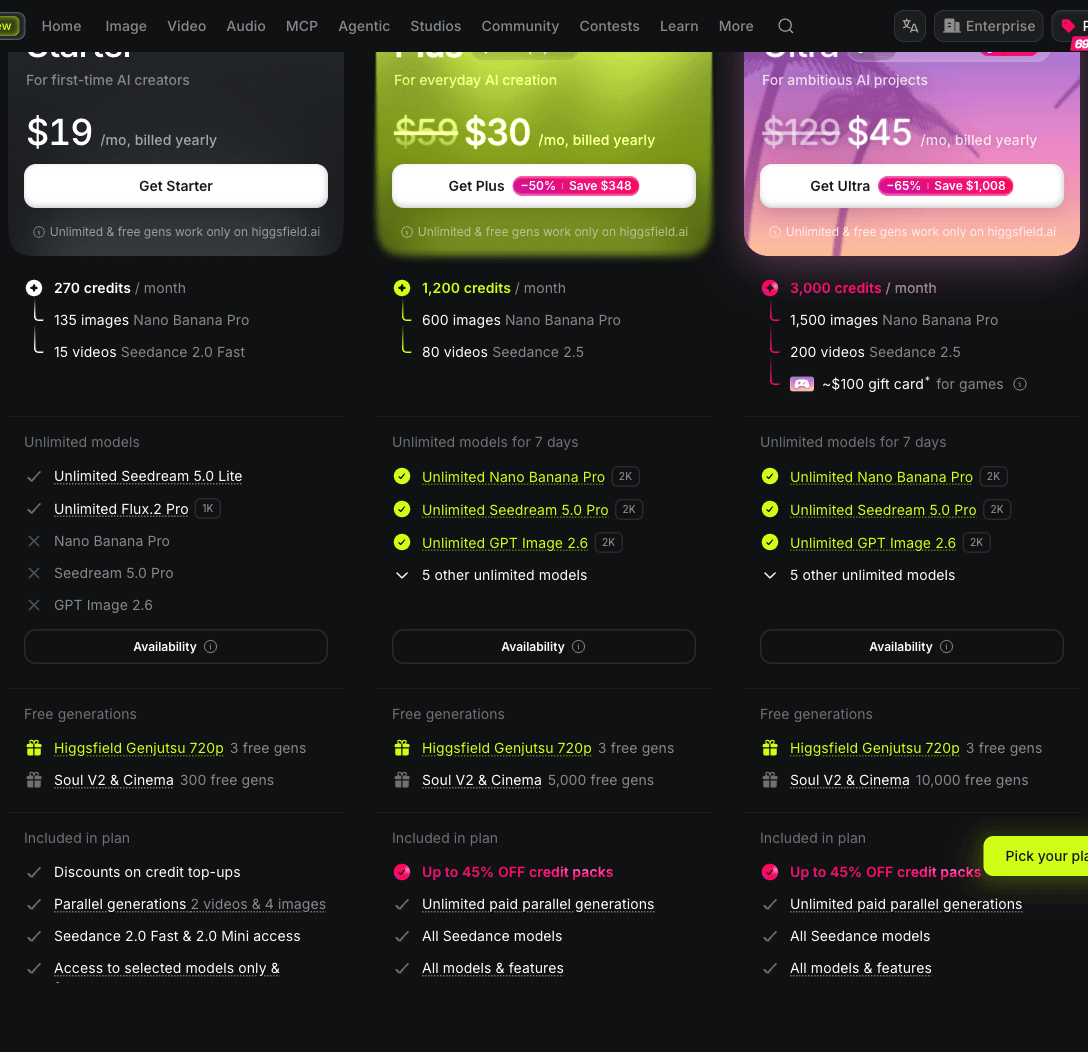
| Plan | Displayed monthly equivalent | Monthly credits | Derived cost/credit | Derived H100/hour | Included H100 hours/reset |
|---|---|---|---|---|---|
| Starter | $19 | 270 | $0.0704 | $8.44 | 2.25 hours |
| Plus | $30 | 1,200 | $0.0250 | $3.00 | 10 hours |
| Ultra | $45 | 3,000 | $0.0150 | $1.80 | 25 hours |
The $1.80 Ultra figure therefore applies to the first 25 H100 hours in each credit-reset period, assuming every credit is used for H100 rental. Plus covers 10 hours and Starter covers 2.25 hours on the same basis. Higgsfield says subscription credits expire at the next renewal. Credit Packs and Auto-Refill credits last 90 days.
The L40S is a useful comparison point for Compare AI Cost research. At the Ultra plan value above, 71 credits produce a derived $1.07 per hour. Runpod's published GPU cost guide lists its 48 GB L40S Secure Cloud rate as $1.09 per hour, verified by Runpod on 10 August 2026. The hardware generation and service package still differ, so use the GPU inference benchmarks and a finished workload to compare performance and cost rather than treating the rates as equal.
The subscription calculation is useful for orientation, while the finished-job bill remains the better decision measure. Annual commitment, unused credits, top-up pricing, workspace time and other plan conditions can change the effective cost of completed work. Credits also support Higgsfield's media-generation products, so a team may spread its subscription across several uses.
How to test whether Higgsfield delivers value
Compare AI Cost can test the credit model through user-visible evidence. The test needs one repeatable workload, the credit balance before and after each stage, and a direct GPU rental on comparable hardware. The aim is to measure finished-job value rather than reverse-engineer Higgsfield's private cost base.
| Test | What to record | Benefit for the user |
|---|---|---|
| Billing-clock test | Credits at launch, workspace readiness, active work, idle time, stop and final shutdown | Shows which parts of the session consume credits and whether setup or idle time changes the effective rate |
| Finished-job value test | Identical input and output, total elapsed time, useful GPU time, credits, retries, file movement and manual setup steps | Shows whether the prepared workspace saves enough time to justify its complete cost against a direct rental |
| Stress and recovery test | A sustained workload, VRAM use, throughput, throttling, failed work, restart behaviour, persistence and recovery time | Shows whether performance and credit efficiency remain stable when the workload runs longer or something fails |
finished-job cost = credits consumed × actual cost per credit + extras + operator timeThe strongest first experiment is a fixed Blender render or model inference job on the L40S. Run it once through Higgsfield and once on a direct 48 GB GPU rental. A short run exposes setup and billing behaviour; a longer run shows whether convenience continues to offset the price; and a controlled restart tests persistence and recovery. Publishing the timings, credit deltas, screenshots and raw results would turn the first look into evidence that users can reproduce.
What an inference engineer should verify
A GPU name and memory figure establish capacity, while the surrounding system determines how efficiently that capacity becomes useful output. Before relying on Higgsfield for model work, test these parts with one representative workload:
- Runtime compatibility: CUDA, drivers, frameworks, container permissions and the model precision required by the job.
- VRAM headroom: model weights, activations, KV cache and the concurrency or batch size that fits after loading.
- Storage lifecycle: disk performance, persistence, snapshots, stop behaviour and recovery after a new session.
- Network path: region, upload time, download time, latency and data-transfer treatment.
- Observability: GPU utilisation, VRAM use, queueing, logs and credits consumed by each completed workload.
- Reproducibility: templates, pinned versions and a repeatable route from launch to a working environment.
Who is Higgsfield GPU rental for?
Strong potential fit
- Blender, ArtCraft, image and video workflows.
- Small teams that value a prepared cloud workspace.
- LoRA and open-model experiments with limited setup time.
- Creators who want to control a workspace through an AI tool.
- Short projects where setup speed carries measurable value.
Compare more closely
- Sustained production inference with strict cost targets.
- Cluster workloads that require detailed networking evidence.
- Teams that need regions, service levels and availability feeds.
- Automated infrastructure built around a provider API.
- Buyers optimising solely for the lowest raw GPU-hour.
Higgsfield compared with Runpod and Vast.ai
These services expose different buying experiences, so a direct rate comparison can hide the value of setup, control and included tooling. Use this table to decide which route deserves a workload test.
| Route | Buying unit | Dated H100 price context | Setup and control | Best initial fit |
|---|---|---|---|---|
| Higgsfield GPU rental | Credits per running minute | $1.80 to $8.44/hour derived from UK plan values, within included credits | Guided workspace, applications and AI-assisted controls | Creative and experimental work that benefits from fast setup |
| Runpod | GPU time, serverless worker time or contracted capacity | H100 PCIe at $2.89/hour Secure Cloud or from $1.99/hour Community Cloud | Pods, templates, volumes, endpoints and infrastructure controls | Teams choosing between interactive compute and serving routes |
| Vast.ai | Marketplace instance rate plus applicable extras | Provider advertises H100 access from $0.90/hour; live listing, storage and transfer terms vary | Broad host marketplace with listing-specific configuration | Buyers willing to evaluate individual hosts for price and fit |
Verdict and the next test
Higgsfield has created an interesting gateway between a raw GPU rental and a creative application. That can be valuable when the saved setup time outweighs a higher effective compute rate or when one subscription serves several Higgsfield workflows.
This remains a source-led first look. A hands-on test should measure launch time, file transfer, application readiness, workspace persistence, stop behaviour, recovery and the cost of one completed workload on a comparable GPU. Those measurements can replace the plan-equivalent estimate with a finished-job comparison.
Frequently asked questions
What is Higgsfield GPU rental?
Higgsfield GPU rental is a rented cloud-computer experience for inference, rendering and creative tools. It combines GPU time with a guided workspace, application choices and AI-assisted controls, and Higgsfield says it is available inside Supercomputer with the /gpu command.
How much does a Higgsfield H100 cost per hour?
Higgsfield lists the H100 at 2 credits per minute, or 120 credits per hour. The derived plan-equivalent cost ranged from $1.80 to $8.44 across the active billed-yearly amounts shown to a UK visitor on 24 November 2026. The $1.80 Ultra figure covers up to 25 H100 hours per credit reset if every included credit is used for GPU rental. Top-up credits have a separate checkout price.
Is Higgsfield cheaper than Runpod or Vast.ai?
The answer depends on the subscription, used and unused credits, GPU, workload duration and value of the included workspace. Compare one finished workload because the services package setup and infrastructure differently.
Do Higgsfield credits show the full GPU price?
Credits show how quickly a Higgsfield GPU session consumes the balance. The public pricing pages present compute, memory, storage, transfer, workspace features and platform margin as one unitemised rate, so finished-job cost provides the stronger comparison.
What should I test before choosing Higgsfield GPU rental?
Run one representative job and record launch time, file transfer, application readiness, workspace persistence, stop behaviour, recovery and total credits consumed. Compare that finished-job result with a direct GPU service on similar hardware.
Sources and checking date
Product claims, GPU credit rates, plan terms and service capabilities were checked against the linked official pages on . Higgsfield remains the authority for current availability and commercial terms. The plan capture came from a UK browsing session before checkout tax. Dollar-per-credit, included-hour and dollar-per-hour figures are Compare AI Cost calculations based on the displayed annual-plan equivalents. The top-up formula uses official credit requirements, while the current top-up price must be checked at checkout.