A real constraint: 75¢ an hour only helps when capacity exists
Scaletific produces animated films for Automation Switch. In one recent workflow, Scaletific capped the Runpod search at $0.75 per GPU hour. If a suitable Pod was missing, the search checked the allowed regions three times, 15 minutes apart. When capacity still had not appeared, the render returned to the next scheduled run.
This turns an hourly ceiling into an operational rule. The price limit protects the budget, while the regional search and polling window protect the time spent waiting. A provider with a lower published rate can still be the slower route when the required GPU is scarce.
A two-hour render with a 75¢ ceiling
- Maximum compute budget
- 2 hours × $0.75 = $1.50
- Availability rule
- Check allowed regions three times, 15 minutes apart
- Decision
- Start a matching Pod or wait for the next scheduled run
Storage and transfer remain separate checks. The estimate becomes a useful ceiling once every expected charge is included.
Compare AI Cost and Automation Switch are Scaletific projects.
Start with the job and its constraints
A small machine-learning project can mean a two-hour video render, a weekend fine-tune, an image-generation worker or an API that receives a few requests each minute. Each pattern needs a different kind of capacity. A fixed Pod gives you a machine and a working environment. Serverless starts workers for requests. A marketplace gives you more variable offers, locations and reliability choices.
Write down five facts before opening a provider page: the minimum GPU memory, expected running time, tolerance for interruption, data that must persist and the maximum cost for the finished job. Those facts make the provider list much easier to use.
A request-led image project needs a different shape
A separate proof of concept is being designed to turn an ordinary phone photo into a cleaner, more considered image. The planned path keeps a base image model on network storage, adds a LoRA and conversion worker, exposes the process through an endpoint, then returns the result to a Next.js front end.
Persistent model storage, cold-start time and endpoint behaviour matter more here than one isolated hourly rate. A Pod can help during development and debugging. Serverless can fit the later application when requests are intermittent and workers can scale down between bursts. The architecture can move from one to the other as demand becomes measurable.
How six GPU rental providers fit small projects
| Provider | Useful starting point | Cost and capacity check |
|---|---|---|
| Runpod | Pods for development and rendering, with a path to Serverless endpoints and persistent storage. | Check the exact GPU, region and storage type. Workers remain billable during their configured idle wait. |
| Vast.ai | Marketplace offers for experiments, checkpointed training and portable jobs that can follow available capacity. | Hosts set compute, storage and bandwidth terms. Prices and reliability vary by offer and location. |
| Modal | Code-led inference and batch functions that benefit from automatic scaling and per-second resources. | Add GPU, CPU, memory, volume and transfer charges. Container load and configured idle time can also be billable. |
| Hostinger | Hourly GPU instances with root access, included storage and transfer, plus templates for image and inference work. | The complete first hour is charged at deployment. Credit pack size changes the effective US-dollar rate. |
| DigitalOcean | Conventional GPU Droplets for persistent applications, training and steady inference with familiar server operations. | Billing runs per second with a 60-second or one-cent minimum and continues until the Droplet is destroyed. |
| SaladCloud | Retryable rendering, image generation and batch inference on distributed RTX-class capacity. | Priority changes price and interruption risk. Match the tier to the job's ability to restart or move. |
Match the provider shape to the workload
Rendering and image generation
Look for enough VRAM, a portable container, useful regional supply and storage that keeps inputs and outputs where you need them. Runpod, Vast.ai and SaladCloud are sensible early comparisons.
Request-led inference
Measure cold starts, idle billing, concurrency and how the endpoint returns results. Modal and Runpod Serverless are useful starting points, with Vast.ai offering a marketplace-backed serverless route.
Fine-tuning and training
Prioritise memory, checkpointing, predictable run time and attached storage. DigitalOcean, Vast.ai and Runpod offer different balances of managed capacity, marketplace choice and flexible Pods.
Small experiments
Start with the shortest useful benchmark. Record time to first result, runtime, retries and every extra charge before choosing the longer rental route.
Calculate the finished-job cost
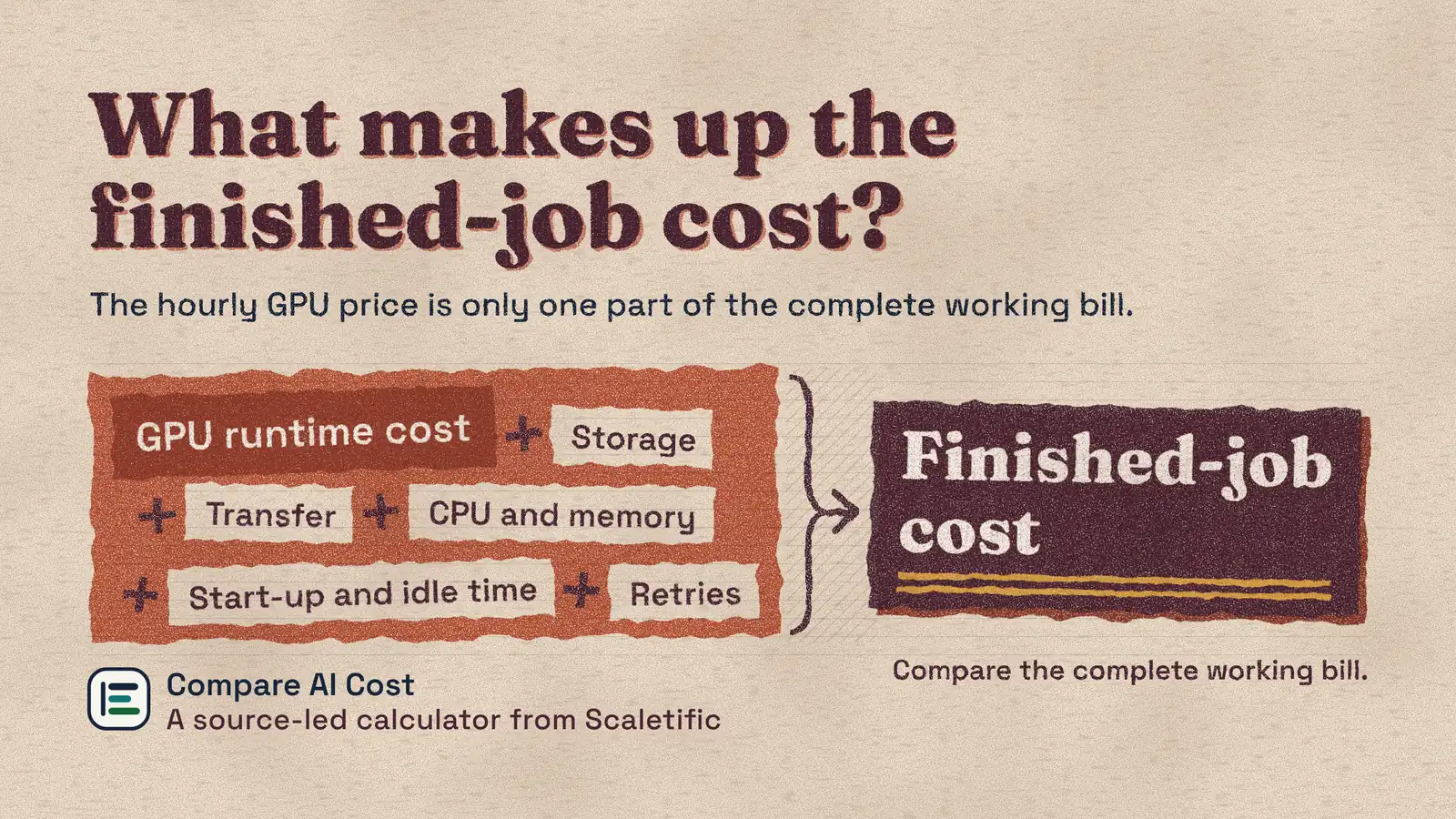
Begin with GPU rate multiplied by running time. Then add persistent storage, network transfer, CPU and memory, start-up and idle time, plus the cost of work repeated after an interruption. The lowest hourly figure can produce a higher finished-job cost when a job waits, restarts or moves large files.
Compare AI Cost keeps the current provider examples visibly separate because they describe different GPUs and billing models. Use them to form a shortlist, then confirm live capacity and the exact machine on the provider page before renting.
The GPU billing guide shows how per-second, complete-hour and marketplace rules change the charge for the same short job.
A practical first rental
Use these six checks in order before committing to a longer GPU rental.
- Confirm the model's minimum memory and working headroom.
- Set a maximum cost for the complete job.
- Choose how much interruption and waiting the job can absorb.
- Check storage persistence, transfer terms and billing states.
- Run a short benchmark and record time to a usable result.
- Scale the rental only after the measured result fits the budget.
Frequently asked questions
Which GPU rental provider should a small AI project start with?
Runpod is a practical starting point when a project needs a flexible Pod, persistent storage or a path to a serverless endpoint. Modal suits code-led, request-driven inference, while Vast.ai and SaladCloud can suit price-sensitive work that tolerates changing capacity or interruption.
How much GPU memory does a small AI project need?
The model, precision, batch size and workflow set the memory requirement. Check the model documentation and leave working room for the runtime, LoRA, image pipeline or training batch before choosing a GPU class.
Why can the cheapest GPU rate be unavailable?
GPU capacity changes by provider, region, machine type and priority. Marketplace and community supply can move quickly, so a useful search checks several regions and treats availability as part of the buying decision.
Should I use a GPU Pod or a serverless endpoint?
A Pod fits development, rendering and longer sessions where you want a machine and attached storage. Serverless fits request-led inference where workers can start for demand and scale down after the idle period.
Does the hourly GPU price include the complete project cost?
The finished-job cost can also include persistent storage, network transfer, start-up and idle time, CPU and memory, failed attempts and repeated work after interruption. Check each provider's billing basis before renting.
Sources and checking date
Commercial prices and plan terms were checked against the provider pages on . Provider pages remain the price authority.
Provider capabilities and billing rules can change. Confirm live capacity and terms before starting a rental.